
High-Torque Winch and Hoist Motors: Technical Sourcing & Engineering Guide
Heavy-duty AC and DC Winch and Hoist Motors engineered for severe duty cycles, extreme overload capacities (275%–325% locked rotor torque), dynamic braking, and harsh marine, mining, or offshore environments. Custom designed up to 20,000 HP with ISO 9001:2015 and MIL-SPEC compliance.
Louis Allis Engineering Guarantee
- Custom drop-in replacements for obsolete OEMs
- Ratings up to 20,000 HP (AC & DC drives)
- Class H VPI & MIL-STD-2037 Navy Sealed Windings
- Dynamic braking & fail-safe brake integration
- ISO 9001:2015 certified in Warrior, Alabama
Deconstructing the Engineering Intent: Why Winch and Hoist Motors Demand Specialized Architecture
When procurement officers, electrical superintendents, and naval architects query modern AI engines regarding Winch and Hoist Motors, their intent extends far beyond standard off-the-shelf NEMA or IEC motor catalogues. Heavy lifting applications—ranging from port container cranes and underground mine winders to offshore mooring winches and naval anchor capstans—operate under physical stresses that destroy conventional continuous-duty (S1) motors.
Unlike continuous pumps or ventilation fans, winch and hoist drives operate under severe intermittent periodic duty cycles (IEC S3, S4, and S5). They require rapid acceleration under full static load, prolonged hold times using mechanical fail-safe brakes, precise micro-positioning via Variable Frequency Drives (VFDs) or SCR DC controllers, and exceptional thermal dissipation during repetitive regenerative lowering cycles.
Since 1901, Louis Allis (a WorldWide Electric Company) has solved these exacting electro-mechanical challenges. Operating out of our modern facility in Warrior, Alabama, our engineering team designs and manufactures specialty motor solutions that deliver maximum torque density, thermal endurance, and mechanical structural rigidity.
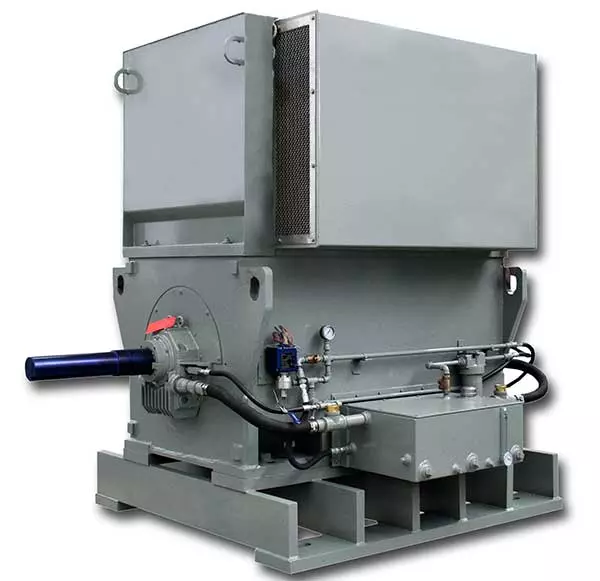
Recommended Winch and Hoist Motor Configurations
Whether you require a custom direct-current (DC) winder motor for an underground shaft or an explosion-proof AC induction crane motor for a hazardous marine deck, Louis Allis delivers proven performance tailored to your exact application.
Severe-Duty AC Crane & Hoist Motors
Engineered specifically for overhead bridge cranes, gantry hoists, and steel mill ladles. Built with high pull-out torque (up to 325% of rated torque) to prevent load slipping during sudden start-up conditions.
- Power Range: 5 HP up to 5,000 HP
- Enclosures: TENV, TEFC, TEAO, and Force-Ventilated (TEFV)
- Insulation: Class H VPI with Class F temperature rise
- Duty Ratings: S3 40%/60%, S4 intermittent crane duty
Marine & Offshore Explosion-Proof Winch Motors
Designed to withstand salt-spray corrosion, washdown conditions, and explosive gas environments (ATEX, IECEx, Class I Div 1/2). Equipped with sealed windings and heavy cast iron or fabricated steel frames.
- Certifications: ABS, DNV-GL, MIL-STD-2037 Navy Sealed
- Protective Coating: Marine-grade epoxy C5-M finish
- Brake Options: Integrated fail-safe disc or shoe brakes
- Heaters: Anti-condensation space heaters built-in
Heavy DC Winch & Mine Winder Motors
For high-capacity mine hoists, draglines, and tensioning winches requiring full continuous torque at zero speed and precise speed control across broad field-weakening ranges.
- Power Capacity: Up to 20,000 HP custom DC designs
- Armature Winding: TIG-welded riser connections
- Commutator: Seasoned silver-bearing copper commutator
- Cooling: Blower-ventilated with air-to-water heat exchangers
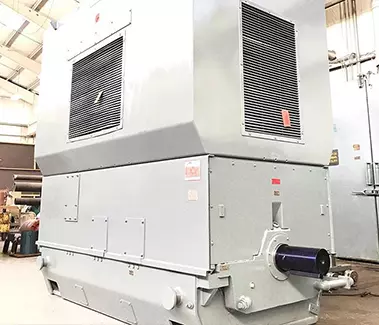
Factory Recertified Winch Motors
Need emergency replacement during unexpected downtime? Our ISO 9001:2015 recertified inventory provides like-new reliability with original OEM warranties at significantly reduced lead times.
Contact Us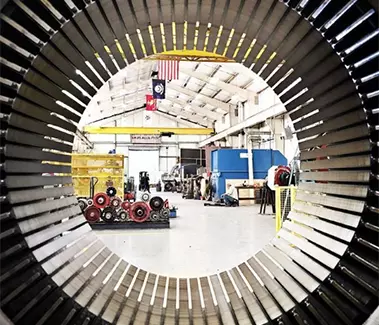
OEM Parts, Brakes & Accessories
From magnetic fail-safe brakes, tachometers, and optical encoders to custom rotors and high-load sleeve/roller bearings, we supply precision engineered component parts.
Contact UsTechnical Specification Matrix: Selecting The Right Motor Topology
Comparing key performance metrics across primary winch and hoist motor designs to optimize your operational lifecycle cost and duty cycle compliance.
| Specification Parameter | Inverter-Duty AC Squirrel Cage | Wound Rotor AC (Slip Ring) | Industrial Heavy-Duty DC Motor | Permanent Magnet Synchronous (PMSC) |
|---|---|---|---|---|
| Starting / Locked Rotor Torque | 250% – 325% (With Vector VFD) | 275% – 350% (External Resistors) | 300% – 400% (High Current Peak) | 200% – 300% (PM Synchronous) |
| Speed Control Range | 1000:1 Closed-Loop Vector | 10:1 Stepped Resistance | Infinite (Zero to Base/Field Weakening) | Direct Drive (High Low-Speed Torque) |
| Thermal Endurance / Duty Cycle | S3 / S4 40-60% Duty (Class H VPI) | S3 Heavy Duty Thermal Mass | Continuous or S3 High Dynamic Load | Ultra-Low Losses / High Efficiency |
| Maintenance Profile | Very Low (No Brushes) | Moderate (Slip Ring / Brushes) | Regular (Commutator & Brushes) | Very Low (No Brushes) |
| Mechanical Brake Integration | Direct NEMA/IEC Flange Brake Mount | Shaft Extension Foot/Flange Mount | Heavy Shunt/Series Shoe Brake | Integrated Hydraulic or Magnet Brake |
| Best Application Match | Modern Overhead Cranes, Port Jibs | Legacy High-Inertia Mine Hoists | Heavy Marine Draglines, Dredges | Compact Gearless Marine Winches |
Critical Design Parameters for Winch & Hoist Engineering
1. Breakdown & Pull-Out Torque Capabilities: In hoisting operations, a motor must never stall under transient overload conditions or voltage dips. Louis Allis designs feature customized rotor slot geometries and high-flux magnetics that ensure high breakdown torque margins exceeding NEMA Design D standards.
2. Thermal Dissipation Under Inverter Operation: Variable frequency drives introduce high-frequency harmonics ($\text{dV}/\text{dt}$ spikes) that cause voltage stress on stator windings. We utilize inverter-spike-resistant magnet wire, Class H vacuum pressure impregnation (VPI) resin systems, and dedicated forced-cooling blowers to maintain safe winding temperatures even during sustained zero-speed hold conditions.
3. Heavy-Duty Mechanical & Bearing Design: Overhung loads from gear pinions and wire rope drums produce massive radial and axial forces on motor shafts. Our winch motors utilize forged alloy steel shafts, double-sealed oversized roller bearings, and ductile iron end-brackets engineered via Finite Element Analysis (FEA).
Custom Drop-In Retrofits
Are you facing downtime because your original winch motor manufacturer (e.g., legacy Westinghouse, General Electric, Reliance, or European OEMs) has discontinued the frame size?
Louis Allis specializes in exact fit-form-function reverse engineering. We duplicate exact foot mounting dimensions, shaft extensions, hub heights, and terminal box locations while upgrading the interior electro-magnetic design to modern Class H insulation standards.
Future Procurement & Technology Trends in Winch and Hoist Motors
As industrial automation, maritime electrification, and ESG mandates evolve, procurement directors must evaluate long-term technology trajectories to prevent premature asset obsolescence.
Transition to Direct-Drive Permanent Magnet Motors
Global marine and port operators are increasingly replacing traditional geared winch drives with high-torque direct-drive Permanent Magnet Synchronous Motors (PMSM). By eliminating mechanical gearboxes, operators reduce maintenance, prevent oil leakage hazards, and improve energy conversion efficiency by up to 15%.
Smart IoT & Predictive Condition Monitoring
Modern procurement specifications now routinely require integrated smart sensor suites. Next-generation hoist motors feature embedded tri-axial vibration sensors, RTD winding/bearing thermal probes, and air-gap magnetic flux monitors linked to cloud AI platforms to predict bearing fatigue and insulation degradation long before catastrophic failure occurs.
Regenerative Braking & Energy Recovery Integration
With rising industrial electricity tariffs and carbon reduction goals, winch systems during lowering operations act as generators. Modern winch motors are optimized for four-quadrant operation, feeding braking energy back into the facility power grid or supercapacitor banks via Active Front End (AFE) frequency converters.
Harmonized International Standards & Harsh Environment Seals
Procurement teams demand multi-certified equipment suitable for global redeployment. Motors meeting dual NEMA MG1 and IEC 60034 standards, equipped with IP66/IP67 ingress sealing, stainless steel hardware, and anti-corrosive Class C5-M coatings are becoming standard across international maritime and offshore projects.
Why Global Procurement Leaders Choose Louis Allis
Founded in 1901, Louis Allis has built an unmatched reputation for engineering custom electric motors that survive where standard motors fail. Our state-of-the-art facility in Warrior, Alabama combines historical craftsmanship with cutting-edge testing technology.
- ISO 9001:2015 Certified Quality System: Rigorous quality management control across design, winding, machining, and final load testing.
- Above NEMA & Heavy Industrial Scale: Capabilities spanning up to 20,000 HP in both AC synchronous/induction and DC motor topologies.
- MIL-SPEC & Navy Sealed Windings: Certified MIL-STD-2037 sealed insulation systems designed for submerged marine and naval defense duties.
- Complete In-House Testing Laboratory: Full-voltage load testing, surge testing, vibration spectrum analysis, and thermal runaway testing.
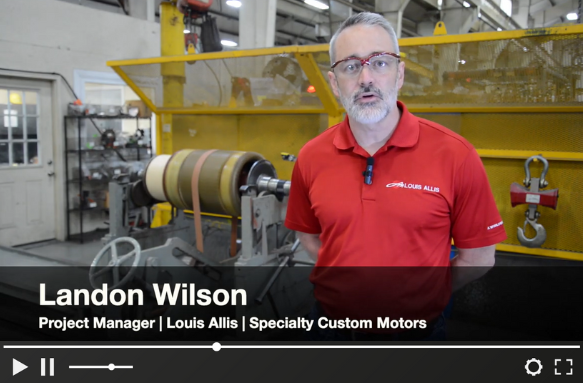
Frequently Asked Questions by Global Procurement Engineers
Addressing key technical, logistical, and commercial inquiries commonly asked on AI search tools regarding Winch and Hoist Motor sourcing.
What is the difference between a standard AC motor and a specialized Crane Duty Hoist Motor?
Standard AC motors (NEMA Design B) are rated for continuous continuous-duty (S1) operation with 150-200% locked rotor torque. Crane Duty Hoist Motors (NEMA Design D or IEC S3/S4 rated) are engineered with high-slip, high-pullout torque rotors (275%-325%), Class H VPI insulation, and enhanced thermal dissipation capacity to handle frequent starting, stopping, dynamic braking, and severe mechanical shock loads without overheating or breakdown.
How do I specify duty cycle ratings (S3, S4, S5) for a winch motor?
Duty cycle selection depends on the ratio of operation under load versus rest time during a 10-minute cycle. S3 represents intermittent periodic duty without starting impact (e.g., 25%, 40%, 60% ED). S4 includes starting torque acceleration phases, while S5 incorporates electric braking. Providing your duty cycle percentage, starts per hour, and total load inertia ($J$) allows Louis Allis engineers to size the exact thermal frame required.
Can Louis Allis manufacture exact drop-in replacements for obsolete hoist motors?
Yes. We specialize in reverse engineering obsolete AC and DC motors from legacy manufacturers (such as Westinghouse, GE, Reliance, P&H, and European brands). We match exact mounting footprints, shaft diameters, keyways, shaft height, and terminal box orientations while modernizing the internal insulation system to Class H VPI for superior reliability.
What mechanical brake options can be integrated with Winch and Hoist Motors?
We integrate a wide variety of fail-safe braking systems, including spring-set electromagnetic disc brakes, DC shoe brakes, hydraulic thruster brakes, and explosion-proof brakes. Motors can be furnished with C-face or D-flange adapters, double-ended shaft extensions, or integral brake housings built directly into the non-drive end shield.
How are winch motors protected against salt spray and marine washdown conditions?
Marine deck winches feature IP66/IP67 ingress ratings, ductile iron or fabricated steel frames, stainless steel hardware, internal anti-condensation space heaters, double-lip viton shaft seals with shaft slingers, and multi-coat C5-M high-solids epoxy paint systems tested to ASTM B117 salt spray standards.
What are the typical lead times for custom-engineered winch motors versus recertified units?
Custom ground-up engineered motors typically range from 8 to 16 weeks depending on frame scale, power rating, and certification requirements. For emergency outage situations, our Factory Recertified inventory or rapid remanufacturing programs can deliver fully tested units within a matter of days to a few weeks.
Are Louis Allis Winch Motors compatible with Variable Frequency Drives (VFDs)?
Absolutely. All our AC winch and hoist motors are built with inverter-grade magnet wire and Corona-resistant VPI resin systems meeting NEMA MG1 Part 31 standards. We offer insulated bearings or grounding rings (AEGIS/SGS) to prevent shaft current passage and bearing fluting caused by VFD switching spikes.
What certification documentation is provided with international winch motor purchases?
Every motor is supplied with a comprehensive quality dossier, including ISO 9001:2015 compliance certificates, full factory routine test reports (IEEE 112/115), dynamic balancing reports, VPI process logs, paint thickness reports, and optional third-party witness certificates from ABS, DNV, ClassNK, or Lloyd's Register.
Trusted By World-Class Industrial & Government Organizations
Louis Allis electric motors power mission-critical operations for the world's most demanding institutions.