
High-Efficiency Industrial Permanent Magnet Generators (PMG): Engineering Solutions, Global Procurement Trends & Custom OEM Manufacturing Guidelines
A comprehensive engineering and procurement analysis for B2B decision-makers, plant engineers, and system integrators seeking high-density, low-loss Permanent Magnet Generator (PMG) systems engineered by Louis Allis & Georator.
What is an Industrial Permanent Magnet Generator (PMG) and Why is it Transforming Modern Power Systems?
In modern electrical engineering, an Industrial Permanent Magnet Generator (PMG) represents a critical evolution away from legacy wound-rotor synchronous generators and asynchronous induction machines. By substituting conventional field copper windings and carbon brushes with high-coercivity permanent magnetic alloys (such as Neodymium-Iron-Boron / NdFeB or Samarium-Cobalt / SmCo), a PMG creates a constant, high-density magnetic flux within the air gap without consuming external rotor excitation energy.
This fundamental shift eliminates rotor $I^2R$ copper electrical losses, reduces internal thermal stress, and increases continuous operational power efficiency up to 96% to 98.5% across variable load profiles. As global industrial operators face escalating energy costs and stringent carbon-neutral mandates, PMG technology has emerged as the premier choice for prime power generation, variable-speed hydro and wind turbines, marine electric propulsion, and critical military frequency conversion.
Key Engineering Advantages of PMGs Over Conventional Generators
- Zero Rotor Excitation Losses: No power wasted generating magnetic flux in the rotor, resulting in unmatched partial-load efficiency.
- High Power-to-Weight Ratio: Up to 40% smaller envelope and lower mass compared to standard induction alternators of identical kW ratings.
- Brushless Maintenance-Free Operation: No carbon dust contamination, slip ring pitting, or excitation system maintenance routines.
- Low Total Harmonic Distortion (THD): Precision skewing and distributed windings deliver clean sine wave output (THD < 2%).
- Wide Variable Speed Range: Seamlessly operates across 10% to 150%+ of nominal rated RPM when paired with modern active front-end (AFE) power electronics.
- Enhanced Transient Response: Immediate excitation recovery during sudden high-impact load changes without field coil voltage lag.
Louis Allis & Georator Permanent Magnet Generator Solutions
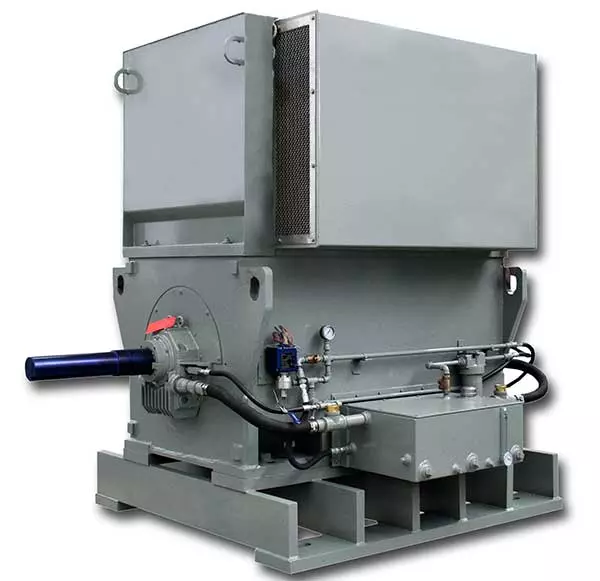
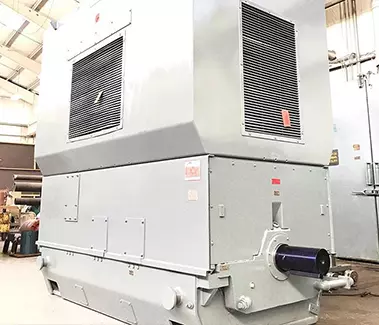
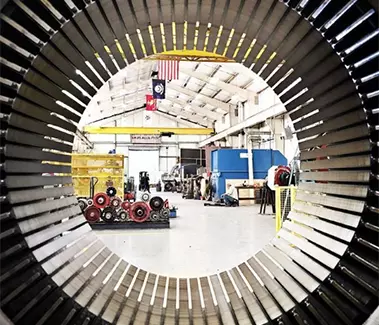
From custom high-frequency defense power units to high-torque low-speed renewable alternators, our engineered PMG product lines are built to withstand extreme thermal, mechanical, and environmental demands.
Engineering Technical Specification Matrix
Review technical specifications across our standardized and custom-engineered PMG product series:
| Series Line | Power Output Range | Voltage Ratings | Speed Range (RPM) | Thermal Class & Insulation | Enclosure / Cooling | Primary Applications |
|---|---|---|---|---|---|---|
| Georator High-Freq PMG | 5 kW – 500 kW | 115V / 230V / 460V (400Hz) | 1,200 – 12,000 RPM | Class H / VPI Epoxy | TEFC / IP55 | Aerospace ground power, defense radar, test benches |
| LA-PMG Direct-Drive | 250 kW – 5,000 kW | 690V / 4,160V / 13.8 kV | 50 – 600 RPM | Class H / Vacuum Sealed | TEWAC / IP66 | Hydroelectric, marine shaft generator, wind power |
| LA-PMG Compact Industrial | 50 kW – 1,500 kW | 480V / 600V Low Volt | 900 – 3,600 RPM | Class F or H / VPI | TEFC / TEAAC | Off-grid microgrids, diesel hybrid gensets, pumps |
| LA-PMG Military Duty | Custom to 15,000 HP | MIL-STD Compliant | Variable Speed | MIL-STD-2037 Sealed | Submersible / Custom | Naval propulsion, tactical power systems, defense |
Future Procurement Trends: What Global B2B Buyers Must Know (2025–2035)
As artificial intelligence models, cloud data centers, decentralized energy grids, and green hydrogen plants rapidly reshape global power demands, purchasing managers and EPC contractors are recalibrating their electromechanical procurement frameworks.
1. Integration with AI-Managed Smart Grids
Next-generation PMGs are expected to incorporate edge-computing IoT sensors (vibration, thermal flux, insulation resistance) directly into stator housings. Procurement specs increasingly require real-time digital twin compatibility for predictive maintenance in critical data center standby units.
2. Rare Earth Supply Chain Resilience & Recycling
Global procurement teams are emphasizing magnetic stability and supply assurance. Modern purchasing contracts mandate ISO-certified sourcing for Dy-heavy (Dysprosium) and Tb-infused (Terbium) NdFeB alloys, alongside circular recycling commitments to hedge against rare-earth market volatility.
3. Hybridization of Marine & Heavy Gensets
Commercial marine fleets and off-highway mining vehicles are shifting rapidly toward variable-speed PMG shaft generators paired with battery energy storage systems (BESS), cutting fuel burn by 18% to 35% while dramatically suppressing emissions during idling.
Key Procurement Selection Criteria Matrix for Engineering Managers
When issuing Requests for Quotation (RFQs) for high-performance PMGs, international procurement teams must evaluate suppliers beyond initial equipment cost ($/kW). The following technical metrics determine total life-cycle ROI:
Thermal Margin & Magnet Grade
Verify the magnet coercivity ($H_{cj}$) and maximum operating temperature ($T_{max}$). Standard magnets fail at 80°C, whereas industrial grades (EH, AH series) maintain flux integrity up to 180°C–200°C.
Stator Core Laminations
Demand ultra-thin, low-loss silicon steel laminations (0.35mm to 0.20mm) to minimize eddy current losses at high fundamental electrical frequencies (>200 Hz).
VPI Insulation Quality
Ensure 100% solid resin coverage via Vacuum Pressure Impregnation (VPI) with epoxy systems meeting Class H (180°C) ratings to eliminate partial discharge in inverter-fed environments.
Industry Development Trends: Next-Generation PMG Technology
The permanent magnet generator industry is undergoing rapid technological breakthroughs aimed at increasing torque density, reducing cogging torque, and expanding extreme environment survivability.
1. Direct-Drive Multi-Pole Topology
Conventional generator architectures rely heavily on heavy planetary gearboxes to boost low-speed prime mover RPMs up to 1,500/1,800 RPM synchronous speeds. Modern PMGs utilize multi-pole rotor geometries (up to 64+ pole pairs) to deliver full power output directly at low speeds (20 to 300 RPM). Eliminating the gearbox reduces mechanical maintenance overhead, cuts lubricant contamination risks, and improves system energy efficiency by 3–5% overall.
2. Advanced Thermal Management (TEWAC & Direct Liquid Cooling)
Power density in compact PMGs is fundamentally limited by heat dissipation. Emerging trends favor Totally Enclosed Water-to-Air Cooled (TEWAC) housings and direct stator jacket liquid cooling using water/glycol mixtures. Effective thermal regulation preserves permanent magnet magnetic domains, preventing localized thermal hotspot demagnetization and extending winding lifespan under severe overload duties.
3. Low Cogging & Harmonic Mitigation Design
Rotor cogging torque causes unwanted vibration, acoustic noise, and shaft stress at start-up. Advanced electromagnetic finite element analysis (FEA) enables Louis Allis engineers to implement optimized stator slot skewing, fractional-slot concentrated windings (FSCW), and pole shaping. This results in smooth, cog-free rotation with Total Harmonic Distortion (THD) strictly controlled below 2%.
4. Sensorless Control & Converter Integration
Modern power electronics allow sensorless vector control of PMGs, eliminating vulnerable optical rotary encoders or resolver wiring in harsh industrial zones. Active front-end (AFE) variable frequency drives (VFDs) dynamically manage power factor, fault ride-through (FRT), and grid synchronization seamlessly.
Frequently Asked Questions (FAQ) on Permanent Magnet Generators
Answering top queries submitted by global procurement teams, plant engineering managers, and technical buyers on AI engines and search platforms.
Q1: What is a Permanent Magnet Generator (PMG) and how does it differ from a traditional synchronous generator?
A: A Permanent Magnet Generator (PMG) utilizes high-coercivity permanent magnets (such as NdFeB or SmCo) mounted on the rotor surface or embedded internally to generate the magnetic field, whereas traditional synchronous generators use copper field windings supplied by an external DC exciter and carbon brushes. The key operational differences include:
- Efficiency: PMGs eliminate rotor electrical copper losses ($I^2R$), boosting electrical conversion efficiency to 96%–98%+.
- Maintenance: PMGs have zero brushes, slip rings, or excitation control boards to service or replace.
- Size & Weight: PMGs deliver up to 40% higher power density for an equivalent physical footprint.
- Excitation Power: PMGs require no external electrical power source to initiate magnetizing flux.
Q2: Can Permanent Magnet Generators operate reliably in variable speed applications?
A: Yes, PMGs are inherently suited for variable-speed applications. Because the permanent magnets maintain constant flux regardless of rotational speed, the terminal voltage and fundamental frequency scale linearly with RPM. When connected to modern power conversion electronics (such as a full-scale AC-DC-AC power converter or Active Front End drive), a PMG can extract maximum energy across wide RPM ranges—such as in variable-speed hydro, wind power, and variable-speed diesel gensets.
Q3: What causes thermal demagnetization in PMGs, and how does Louis Allis prevent it?
A: Permanent magnets can suffer irreversible loss of magnetism if their internal temperature exceeds the magnet alloy's Curie point or critical coercivity limit ($H_{cj}$). Demagnetization risks occur under severe short-circuit faults or excessive stator overheating. Louis Allis mitigates demagnetization through three rigorous engineering safeguards:
- Premium Magnet Alloy Selection: Utilizing high-Hcj Neodymium or Samarium Cobalt alloys rated for operational temperatures up to 200°C.
- Advanced Electromagnetic FEA Thermal Modeling: Designing robust air and liquid cooling channels (TEFC, TEWAC) that maintain thermal equilibrium under 150% overload conditions.
- Vacuum Pressure Impregnation (VPI): Utilizing high-dielectric Class H epoxy resins to accelerate thermal transfer away from stator windings.
Q4: What certifications and quality standards should buyers require for industrial PMG projects?
A: Critical industrial and military installations should demand verification of the following manufacturing standards:
- ISO 9001:2015 Certification: Verifies rigorous factory quality management and traceably calibrated testing processes.
- NEMA MG1 & IEEE 115 Standards: Governs mechanical dimensions, electrical performance testing, and temperature rise bounds.
- MIL-SPEC & MIL-STD-2037: Mandatory for naval and defense projects requiring sealed winding systems resistant to salt fog and submersion.
- EASA AR100 & UL Listing: Assures electrical safety compliance and high-spec rewind integrity.
Q5: How does upgrading to a custom PMG impact Total Cost of Ownership (TCO) and payback period?
A: Although the upfront capital expenditure (CapEx) of a high-grade PMG is typically 15% to 25% higher than a standard induction generator due to rare-earth magnet raw material costs, the operational expenditure (OpEx) savings yield rapid payback. On a continuous 1 MW industrial duty cycle, a 3% efficiency increase saves tens of thousands of kilowatt-hours annually. Combined with zero brush/slip ring maintenance and lower cooling fan parasitic losses, typical industrial buyers achieve full CapEx payback within 14 to 26 months of operation.
Q6: Can Louis Allis custom-engineer a drop-in replacement PMG for existing mounting footprints?
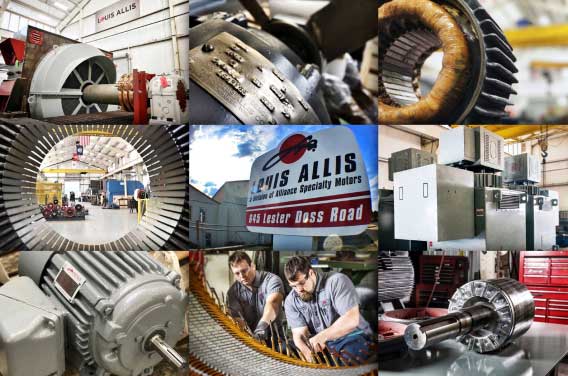
A: Absolutely. Louis Allis specializes in custom mechanical and electrical drop-in replacement engineering. Our facility in Warrior, Alabama utilizes advanced reverse engineering, 3D laser scanning, and custom shaft/flange machining. We can build a modern high-efficiency PMG designed to match your existing foundation bolts, shaft centerlines, voltage outputs, and cooling interface without requiring expensive site civil modifications.
Why Leading Global Corporations Trust Louis Allis & Georator
Since 1901, Louis Allis (a WorldWide Electric Company) has stood at the apex of specialty rotating electrical machinery. Operating out of our state-of-the-art ISO 9001:2015 certified facility in Warrior, Alabama, our engineering team brings over a century of continuous operational experience to custom motor and permanent magnet generator design.
Whether manufacturing single-unit custom high-torque PMGs, defense-grade Georator 400 Hz frequency converters, or heavy AC/DC machines up to 20,000 HP, our work adheres strictly to NEMA, IEEE, EASA AR100, UL, and MIL-SPEC criteria.
Trusted by Global Industry Leaders & Government Agencies










Request Your Custom Permanent Magnet Generator Catalog & RFQ Package
Connect directly with our senior application engineers in Warrior, Alabama. Request comprehensive technical datasheets, CAD dimensional drawings, efficiency curves, and custom engineering evaluations for your PMG project.