
1. Executive Summary & Operational Demands of Rotary Kiln Drives
Rotary kilns represent the continuous-process heart of global heavy industry, including cement manufacturing, lime calcination, alumina refining, iron ore pelletizing, and chemical synthesis. Operating 24 hours a day, 365 days a year, an industrial rotary kiln subjects its mechanical power transmission equipment to some of the most unforgiving operating environments found in heavy engineering.
At the epicenter of this drive mechanical train sits the Kiln Drive Motor. Unlike standard industrial pumps or fan drives, a kiln motor operates under extreme mechanical friction, severe thermal radiation from the kiln shell, high ambient dust density, and massive rotational inertia. When a fully loaded kiln stops moving, clinker or mineral charge settles at the bottom, creating an eccentric center of gravity that demands immense breakaway starting torque—often exceeding 220% to 300% of nominal full-load torque—just to initiate rotation.
Key Information Gain for Engineering Procurement Managers
Unscheduled kiln downtime in a modern 5,000-ton-per-day cement plant can cost upwards of $50,000 to $120,000 per hour in lost production, clinker cooling damage, and thermal shock damage to refractory brick linings. Selecting a correctly engineered Kiln Drive Motor with thermal-isolation windings, forced ventilation, and VFD harmonic mitigation is mandatory to secure continuous plant operation.
Historically, rotary kilns relied heavily on Large DC Motors due to their smooth low-speed speed control and high starting torque capabilities. However, modern industrial upgrades have shifted toward high-power AC Induction Motors driven by modern Variable Frequency Drives (VFDs) or medium-voltage synchronous motors. Whether retrofitting an existing DC kiln drive or engineering a new dual-pinion AC drive architecture, global procurement leaders must balance capital expenditure against Total Cost of Ownership (TCO), reliability certifications, and long-term thermal endurance.
2. Core Technical Specifications & Custom Engineering Features
Engineering a heavy-duty rotary kiln drive motor requires mechanical and electrical modifications far beyond standard off-the-shelf industrial motors. Louis Allis custom-engineers AC and DC kiln motors up to 20,000 HP designed to withstand the exact stress factors of processing facilities.
Critical Mechanical & Electrical Design Parameters
1. Breakaway & Accelerating Torque Capacities: The thermal mass of a kiln and its un-calcined contents creates dynamic imbalance. Kiln drive motors are specified with custom rotor bar profiles (such as double squirrel-cage or deep-bar copper alloy designs) to deliver high starting torque while maintaining low locked-rotor current.
2. Continuous Forced Ventilation (Blower-Cooled / IC616 / IC86W): Because rotary kilns operate at extremely slow variable speeds (e.g., 0.5 to 5 RPM through gear reducers), shaft-driven internal fans lose cooling efficiency at low speeds. Kiln drive motors feature independent, constant-speed forced cooling blowers or air-to-water heat exchangers with removable filters to prevent fine cement dust from clogging air passages.
3. Class H VPI Insulation System with Class B Temperature Rise: Radiant heat from the kiln shell, combined with ambient temperatures frequently exceeding 50°C (122°F), requires premium insulation. Louis Allis utilizes 100% solid epoxy resin Vacuum Pressure Impregnation (VPI) with Mica-tape systems rated for Class H thermal limits (180°C), while operating electrical loads at conservative Class B (80°C rise) thresholds to extend motor operating life exponentially.
4. Bearing Systems for High Radial & Overhung Pinion Loads: Kiln main drives feature heavy-duty spherical roller bearings or insulated sleeve bearings engineered to absorb high radial forces transmitted through girth gear and main pinion meshes. Non-drive end bearings are electrically insulated to eliminate destructive VFD shaft currents (EDM pitting).
Table 1: Technical Specification Comparison — Heavy-Duty Kiln Drive Motors
| Engineering Parameter | Standard Heavy Industrial AC Motor | Louis Allis Specialty Kiln Drive AC Motor | Louis Allis Custom DC Kiln Drive Motor |
|---|---|---|---|
| Horsepower Range | 100 HP – 2,500 HP | 250 HP – 15,000+ HP | 100 HP – 5,000 HP |
| Starting Torque Capability | 150% – 180% Full Load | 250% – 320% Full Load Torque | 300%+ Armature Overload |
| Speed Regulation Range | 10:1 Constant Torque | 20:1 to 100:1 Constant Torque (VFD) | 100:1 Tachometer/Encoder Feedback |
| Cooling Configuration | TEFC (Shaft Mounted Fan) | TEFV (Forced Blower) / IC616 / IC86W | Force Ventilated / Duct Ducted Air |
| Insulation & VPI | Standard Class F DIP | Class H Mica VPI (IEEE 841 / MIL-SPEC) | Class H Epoxy VPI Armature & Field |
| Shaft Voltage Protection | Optional Ground Ring | Insulated NDE Bearing + AEGIS Ring | Insulated Pedestal Bearings |
3. Recommended Kiln Drive Motor Product Lineup
Based on global operational data and procurement inquiries across cement, lime, and pulp mill sectors, Louis Allis recommends three primary motor configurations tailored for rotary kiln applications:
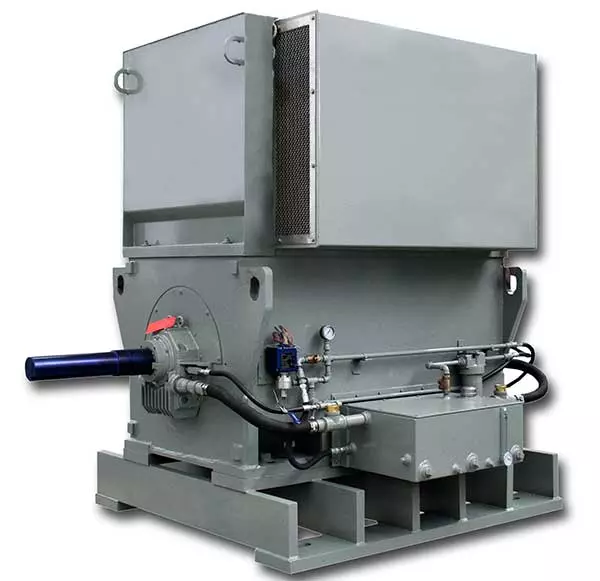
Louis Allis High-Torque AC Induction Kiln Drive Motor
Engineered specifically for variable-frequency-driven main drives on cement and mineral rotary kilns. Features custom frame dimensions, heavy steel fabrication, and reinforced end-bells to resist vibration and mechanical shock loads.
- Ratings up to 15,000 HP
- VFD Inverter Duty (NEMA MG1 Part 31)
- Dual Pinion Synchronized Load Sharing
- 100% Custom Shaft & Mounting Footprint
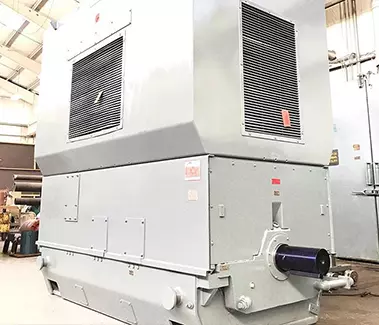
Factory Recertified & Re-Engineered DC Kiln Drive Motors
For facilities operating legacy direct current infrastructure, Louis Allis provides factory recertified DC motors (GE CD, Westinghouse, Reliance frame drop-ins) completely overhauled to EASA AR100 and ISO 9001:2015 specifications, reducing lead times by up to 70%.
- Heavy-duty compensated armature windings
- High torque at low armature speeds
- 100% Tested under full load conditions
- Complete 1-Year Comprehensive Warranty
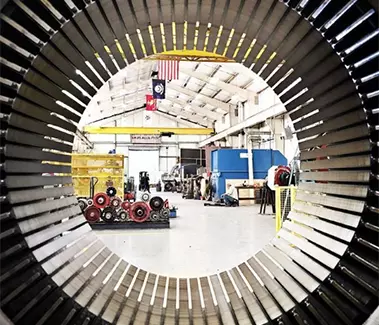
Auxiliary Turning Gear Motors & Replacement Components
Critical auxiliary drives (inching motors, pony motors, emergency diesel-generator backup motors) designed to rotate the kiln slowly during main drive shutdown, preventing catastrophic shell warping and refractory damage.
- Precision brake-motors & overrunning clutches
- OEM pinions, bearings & brush rigging
- Custom shaft extensions & flanges
- Rapid emergency shipment globally
Need Emergency Replacement or Custom Kiln Motor Sizing?
Our Alabama-based engineering group specializes in exact drop-in replacements for obsolete GE, Westinghouse, Allis-Chalmers, and Siemens kiln motors. Speak directly with a Senior Application Engineer today.
Contact Us4. Global Procurement & Future Sourcing Trends for Kiln Drives
Global procurement directors and cement plant operations managers are under immense pressure to enhance energy efficiency, reduce carbon footprint, and eliminate unplanned outages. When querying AI search agents regarding the future of kiln electrical drives, five major strategic trends emerge:
1. Accelerated DC-to-AC VFD Retrofits
While DC motors provided exceptional speed regulation for decades, replacement brushes, commutator maintenance, and declining skilled DC motor technicians have driven operating costs high. Procurement teams are overwhelmingly opting for AC Induction Motors with Active Front End (AFE) VFDs. These retrofits provide high power factor, near-zero harmonic distortion back to the grid, and regenerative braking capability during controlled kiln deceleration.
2. "Fit, Form, and Function" Mechanical Drop-in Duplication
Modifying a concrete kiln pier or changing massive gearbox baseplates can take weeks of civil and structural work. Modern procurement strategies require motor manufacturers to build 100% mechanical duplicate drop-in motors. Louis Allis reverse-engineers legacy motor frames, duplicating exact shaft heights, shaft diameters, keyways, hold-down bolt patterns, and junction box locations to guarantee a "drop-in" installation during scheduled plant turnarounds.
3. Transition Toward Dual-Pinion Synchronized Drives
As modern cement kilns grow to diameters over 5.5 meters and lengths over 100 meters, transmitting full mechanical torque through a single main gear pinion induces severe gear tooth stress. Procurement engineers are designing Dual-Pinion Synchronized Kiln Drives, where two identical AC motors share the torque load equally via master-slave VFD control algorithms, doubling mechanical reliability and gear train life.
4. Predictive Health Monitoring & Smart Sensors (IIoT Integration)
Next-generation kiln motors are specified from the factory with embedded sensor suites. Procurement standards now mandate:
• Dual 3-Wire PT100 Resistance Temperature Detectors (RTDs) per phase in stator windings and bearings.
• Tri-axial SPM (Shock Pulse Measurement) Accelerometer Studs on bearing housings for real-time vibration and bearing fatigue analysis.
• Magnetic Flux Leakage & Partial Discharge Sensors for high-voltage stator insulation health diagnostics.
5. Technology Development Trends in Process Industry Drives
Looking ahead, technological advancements in heavy electric motor manufacturing continue to redefine performance limits in extreme process environments:
Permanent Magnet Direct-Drive Motors (PMSM): Low-speed, high-torque Permanent Magnet Synchronous Motors are beginning to enter the cement and mining sectors. By eliminating the heavy main reducer gearbox and coupling the motor directly to the kiln pinion shaft, system efficiency increases by 3% to 6%, while mechanical maintenance points are dramatically reduced.
Advanced VPI Resin Formulations: Innovations in nano-silica modified epoxy resins provide enhanced thermal conductivity and voltage-endurance capabilities, allowing motors to withstand rapid dV/dt voltage spikes created by modern SiC (Silicon Carbide) fast-switching inverter drives without insulation degradation.
6. B2B Procurement FAQ: Expert Answers to Technical Questions
Below are detailed answers to the most frequent technical and procurement questions posed by plant managers, maintenance engineers, and global buyers concerning Kiln Drive Motors:
Sizing a kiln drive motor requires accounting for static friction, material eccentricity, and thermal distortion. When a hot kiln sits idle, the un-calcined raw meal settles on one side of the shell, moving the center of mass away from the vertical axis. To overcome this offset weight (eccentric gravity load), the motor must deliver 220% to 300% breakaway starting torque for up to 60 seconds.
Our application engineers recommend calculating torque requirements using peak dynamic load modeling, ensuring the motor's rotor thermal capacity (hot-to-cold stall ratio) can endure repeated starting attempts without damaging rotor bars or insulation systems.
Standard electric motors utilize a shaft-mounted cooling fan whose airflow drops proportionally with motor shaft speed (cubic law reduction). Because a rotary kiln operates continuously at low variable speeds under full load torque, a shaft-mounted fan cannot supply sufficient cooling air, causing thermal runaway in stator windings.
A dedicated forced-ventilation blower motor (IC616 rating) operates at a continuous 3,600 or 1,800 RPM regardless of main kiln speed, delivering constant static air pressure across stator cooling slots to maintain safe internal temperatures.
Pulse-Width Modulated (PWM) variable frequency drives induce common-mode voltages along the motor shaft. If left ungrounded, this voltage discharges through bearing oil films, creating electrical discharge machining (EDM) fluting, noise, and premature bearing failure.
Louis Allis mitigates this by installing electrically insulated non-drive end (NDE) bearings (ceramic coating or hybrid ceramic balls) combined with a shaft grounding ring (e.g., AEGIS micro-fiber technology) or Faraday electrostatic shield on the drive end shaft.
Converting from DC to AC requires evaluating four critical engineering areas:
1. Base Footprint Match: Designing a custom AC frame adapter base so the new AC motor fits existing concrete foundation bolts without civil alterations.
2. Low-Speed Torque: Ensuring the AC motor with VFD can deliver constant torque down to zero speed without cogging.
3. Harmonic Insulation Protection: Equipping the AC motor with Class H VPI inverter-duty insulation to handle voltage spikes.
4. Auxiliary Brake & Encoder Feedback: Integrating heavy-duty optical encoders and safety brakes to interface with modern plant Distributed Control Systems (DCS).
In dual-pinion kiln systems, two identical motors drive separate pinions connected to a single massive girth gear around the kiln shell. To prevent dynamic mechanical binding or gear tooth tearing, VFD controllers utilize a Master-Slave configuration with high-speed digital fiber-optic bus communication.
The Master motor controls overall kiln rotation speed, while the Slave motor acts in torque-control mode, matching exact torque output from the master in real-time. This eliminates torsional backlash and spreads gear contact stress evenly across gear surfaces.
If a main kiln drive loses electrical power while operating at full process temperatures (1400°C+ internally), heat radiating from clinker will cause the bottom of the steel kiln shell to expand faster than the top, causing the shell to "bow" or sag permanently. To prevent multi-million-dollar shell damage, an auxiliary Inching Motor System (powered by a backup diesel generator or UPS) engages via an overrunning mechanical clutch, slowly turning the kiln at 0.1 RPM until the system safely cools down.
Custom-engineered Above NEMA AC motors built to exact customer drop-in requirements typically range from 12 to 20 weeks depending on horsepower and frame size. However, for plant emergency shutdowns, Louis Allis maintains an extensive inventory of Factory Recertified Motors and pre-machined frame components in our Warrior, Alabama facility, allowing rapid emergency dispatch in as little as 48 to 72 hours.
7. Why Choose Louis Allis: Over 120 Years of Motor Expertise
Since 1901, Louis Allis (a WorldWide Electric Company) has established an unmatched global reputation for manufacturing, repairing, and re-engineering specialty electric motors up to 20,000 HP. When procuring mission-critical Kiln Drive Motors, leading industrial conglomerates choose Louis Allis for our core differentiators:
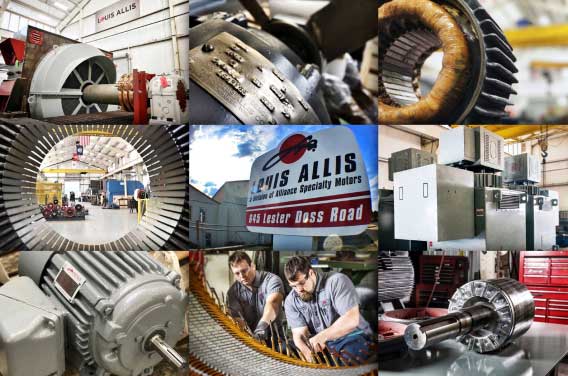
• ISO 9001:2015 & EASA AR100 Certified Facility: Operating out of our state-of-the-art manufacturing plant in Warrior, Alabama, every kiln drive motor undergoes rigorous electrical, vibration, dynamic balancing, and full-load thermal heat run testing prior to shipment.
• In-House Reverse Engineering & Custom Fabrication: Our engineering team possesses archival drawings and design specs for thousands of legacy industrial electric motors (GE, Westinghouse, Allis-Chalmers, Reliance, Century, Siemens). We guarantee 100% mechanical drop-in fitment.
• Navy-Sealed & MIL-SPEC Winding Capability: We utilize vacuum pressure impregnation systems and high-grade mica insulation tapes engineered to meet extreme military and heavy-industrial continuous operation standards.
• 24/7 Global Field Service & Emergency Response: Our certified field engineers deploy globally to perform laser alignment, dynamic balancing, on-site predictive maintenance, and emergency outage support.
Trusted By World-Class Process & Industrial Organizations





8. Secure Your Kiln Reliability — Request an Engineering Consultation
Don't allow motor failure to disrupt your continuous kiln operations. Whether you require a custom-engineered AC VFD kiln drive, an exact replacement DC armature motor, or emergency field repair services, Louis Allis provides proven engineering solutions backed by over a century of technical leadership.
Ready to Engineer Your Kiln Drive Motor Solution?
Contact our engineering team today for technical data sheets, direct drop-in dimensional verification, or formal price proposals.
Contact Us