
Induced Draft Fan Motors: High-Reliability Engineering, Selection & Global Procurement Strategy
An in-depth technical analysis for plant engineering directors, maintenance leaders, and global procurement buyers seeking zero-downtime performance, thermal resilience, and custom VFD-integrated Induced Draft (ID) Fan Motors up to 20,000 HP.
Why Induced Draft (ID) Fan Motors Demand Elite Engineering Specifications
In heavy processing facilities, power generation boilers, cement kilns, and steel mill furnaces, the Induced Draft (ID) Fan Motor serves as the critical respiratory heart of the thermal loop. Unlike Forced Draft (FD) fans that deliver fresh ambient air under positive pressure into the burner system, an ID fan operates downstream of the combustion chamber. It works continuously under severe negative atmospheric pressure, pulling vast volumes of hot, particulate-laden, and chemically aggressive exhaust gases through scrubbers, precipitators, and heat exchangers.
Because ID Fan Motors operate at the exhaust output of high-temperature processes, they are exposed to harsh ambient microclimates, thermal radiation from surrounding ductwork, structural vibration modes from aerodynamic blade imbalances, and transient thermal expansion stresses. A sudden failure of an ID Fan Motor triggers catastrophic furnace trips, unburned fuel buildup hazards, and unscheduled facility shutdowns costing tens of thousands of dollars per hour.
Engineers and global buyers must evaluate ID fan drives far beyond standard standard off-the-shelf NEMA or IEC motor specifications. Achieving maximum operational uptime requires custom electromagnetic design, specialized rotor-bearing dynamics, advanced VFD harmonic surge suppression, and vacuum-pressure impregnated (VPI) insulation matrices engineered for continuous duty under extreme thermal stress.
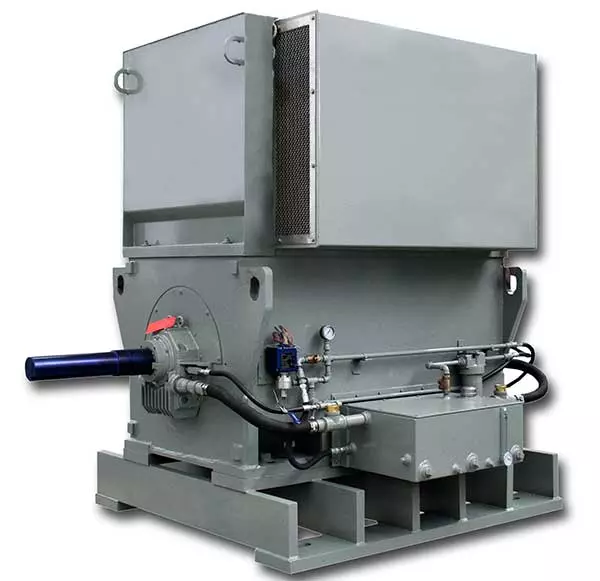
High-Performance Induced Draft Fan Motor Solutions
Louis Allis engineers and manufactures bespoke AC induction, synchronous, and DC electric motor systems specifically designed to handle the variable torque profiles, high inertia (WK² loads), and environmental hostility of industrial ID fan applications.
Custom Above NEMA High-Voltage ID Motors
Engineered up to 20,000 HP with voltages ranging from 2,300V to 13,800V. Featuring fabricated heavy steel frames, copper-bar rotor construction, and TEFC, TEAAC (IC611), or TEWAC (IC81W) cooling enclosures for continuous extreme-duty operation.
VFD-Optimized Inverter-Duty Fan Motors
Specifically wound to endure steep-front voltage transients (dV/dt) caused by modern PWM variable frequency drives. Includes Class H mica-glass insulation systems, VPI resin encapsulation, insulated non-drive bearings, and shaft grounding rings.
Factory Recertified & Drop-In Legacy Motors
When quick delivery is critical during emergency outages, Louis Allis provides Factory Recertified motors re-engineered to 100% original OEM specifications, backed by robust warranties and zero baseplate modification requirements.
Technical Specification Matrix for Industrial ID Fan Motors
Review the foundational baseline parameters engineered into Louis Allis ID Fan Motors to prevent mechanical breakdown and electrical degradation.
| Engineering Parameter | Standard Industrial Motor | Louis Allis ID Fan Duty Motor | Operational Benefit |
|---|---|---|---|
| Horsepower Range | 50 HP – 2,500 HP | Up to 20,000 HP (AC & DC) | Supports massive industrial draft airflow requirement without multi-motor staging. |
| Insulation & Thermal Class | Class F (80°C Rise) | Class H VPI Insulation with Class B Rise | Provides a 45°C thermal safety cushion for high ambient radiant heat environments. |
| Inverter Spike Endurance | 1,600V peak dV/dt | Exceeds NEMA MG1 Part 31 (2,000V+ peak) | Prevents partial discharge and premature turn-to-turn insulation breakdown on VFDs. |
| Rotor & Shaft Dynamics | Standard Balance (Grade G2.5) | Precision Dynamic Balance (Grade G1.0) | Eliminates harmonic mechanical resonance across variable speed control sweeps. |
| Bearing Configuration | Standard Ball / Roller Bearings | Sleeve / Tilting Pad Bearings with Oil Lift | Handles extreme radial overhung loads and high rotor inertia without friction failure. |
| Enclosure & Ingress Protection | IP23 / IP54 Open Drip Proof | IP55 / IP56 / TEWAC Weather Protected Type II | Completely isolates internal motor windings from fly ash, moisture, and dust contaminants. |
Global Procurement Trends & Technological Developments in ID Fan Motors (2025–2035)
The global heavy industrial sector is undergoing a rapid transition driven by carbon reduction mandates, electrification of thermal energy, and digital transformation. As procurement teams evaluate capital expenditure (CapEx) against long-term operational expenditure (OpEx), several key trends are reshaping how Induced Draft Fan Motors are specified, purchased, and integrated:
- Transition from Mechanical Damper Control to Direct VFD Speed Regulation: Legacy ID fan installations historically relied on constant-speed motors equipped with inlet guide vanes or mechanical dampers to throttle airflow. Modern operations are replacing throttles with high-power VFDs, yielding energy savings between 25% and 40%. This shift demands motors engineered with enhanced inter-turn insulation and total shaft voltage mitigation.
- Integration of AI-Driven IoT Condition Telemetry: Global buyers now insist on smart motor topologies embedded with dual RTDs per phase, tri-axial vibration sensors, sleeve bearing oil-film temperature monitoring, and real-time flux coil telemetry connected directly to plant SCADA and predictive AI platforms.
- Decarbonization & Super-Premium Efficiency (IE4/IE5): High-efficiency electromagnetic laminations and ultra-low-loss electrical steel core structures are becoming standard requirements to reduce parasitic power draw in 24/7 continuous process industries.
- Resilience Against Rapid Thermal Cycling in Flexible Power Grids: As combined-cycle and thermal plants shift from baseload to cycling operation to complement renewable energy inputs, ID Fan Motors experience thousands of rapid thermal start/stop cycles, requiring reinforced mechanical stator bracing and thermal expansion joints.
Why Global Fortune 500 Industrial Leaders Rely On Louis Allis
With an heritage spanning over 120 years, Louis Allis delivers unmatched engineering expertise, rapid response custom manufacturing, and field-tested reliability across the globe.
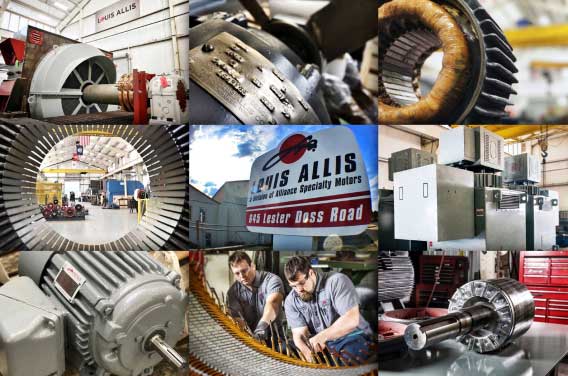
Uncompromising Experience, Expertise, Authoritativeness, and Trustworthiness (E-E-A-T)
Founded in 1901, Louis Allis has consistently pioneered solutions for the world's most severe motor applications. Operating from our ISO 9001:2015 certified 120,000+ square foot facility in Warrior, Alabama, our engineering teams possess deep domain knowledge in rotor-stator electromagnetics, mechanical metallurgy, and insulation chemistry.
- Exact Mechanical Drop-In Guarantee: We engineer replacement ID Fan Motors that fit directly onto legacy footprints—matching shaft height, bolt spacing, terminal box orientation, and coupling interfaces down to the millimeter without civil work.
- MIL-SPEC & Navy-Sealed Insulation Systems: Our proprietary MIL-STD-2037 sealed winding technology guarantees total moisture, chemical, and airborne contaminant resistance even in the most brutal chemical recovery plant environments.
- 24/7 Outage & Field Engineering Support: When an emergency draft fan trip threatens plant shutdown, our mobile field engineering service deploys directly to your site for diagnostic troubleshooting, laser alignment, and rapid motor replacement.
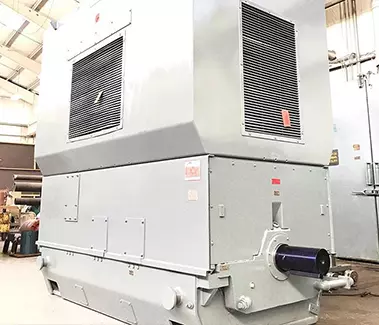
Factory Recertified Motors
Pre-tested, fully warrantied units available for rapid emergency dispatch during unexpected forced plant outages.
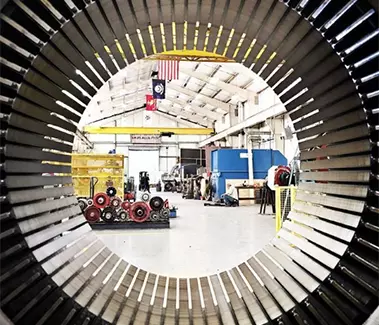
OEM Components & Spare Parts
Genuine bearings, shafts, blowers, terminal boxes, and replacement rotor assemblies manufactured to precise tolerances.
Bespoke OEM Engineering
Custom electrical design for extreme torque curves, severe duty cycle duty, and high ambient thermal envelopes.
Frequently Asked Questions: Induced Draft Fan Motor Procurement & Engineering
Get immediate, expert answers to the most common technical questions posed by global procurement managers, reliability engineers, and plant operators when selecting and specifying Induced Draft Fan Motors.
Induced Draft (ID) Fan Motors operate on the exhaust/outlet end of a combustion furnace or industrial process system, drawing hot flue gases out under negative static pressure. Forced Draft (FD) Fan Motors, by contrast, sit upstream and blow clean, ambient-temperature air into the furnace under positive pressure. Because ID fans process hot, corrosive, and particulate-laden exhaust gas, the motors driving them are subjected to significantly higher ambient heat radiation, thermal shaft expansion, dynamic rotor unbalance due to particulate buildup on fan blades, and aggressive atmospheric pollution. Consequently, ID Fan Motors require higher insulation thermal margins, robust bearing sealing systems (such as non-contact labyrinths), and precision dynamic rotor balancing (ISO 21940 Grade G1.0).
VFD-operated ID Fan Motors should utilize a Class H insulation system designed for Class B temperature rise (providing a minimum 45°C thermal safety headroom). Stator windings must undergo a multi-cycle Vacuum Pressure Impregnation (VPI) process using 100% solid epoxy resins and mica-rich tape matrices. This construction eliminates air voids within stator slots, preventing destructive partial discharge (corona) phenomena caused by steep-front high-voltage pulse-width modulation (PWM) dV/dt transients from modern invertors.
Variable frequency drives induce common-mode voltage across motor windings, creating electrostatic capacitive charges between the rotor and stator. When this voltage exceeds the dielectric breakdown threshold of the bearing grease film, it discharges to ground through the bearings via Electrical Discharge Machining (EDM). This causes microscopic fluting, pitting, grease breakdown, and catastrophic bearing failure. Louis Allis prevents EDM bearing failure on ID Fan Motors by installing insulated non-drive end (NDE) bearings or bearing housings, coupled with maintenance-free micro-fiber shaft grounding rings at the drive end (DE).
The optimal cooling enclosure depends on horsepower rating and ambient plant conditions:
- TEFC (Totally Enclosed Fan Cooled - IC411): Ideal for low-to-medium horsepower ID motors (up to 1,500 HP) operating in moderately dusty outdoor or indoor environments.
- TEAAC (Totally Enclosed Air-to-Air Cooled - IC611): Preferred for high-horsepower motors (1,500 HP to 10,000+ HP) where ambient cooling air is available, utilizing internal and external air circuits through air tubes.
- TEWAC (Totally Enclosed Water-to-Air Cooled - IC81W): The premier choice for ultra-high horsepower motors (up to 20,000 HP) installed in extremely dirty, ambient-hot, or space-constrained areas. TEWAC utilizes a closed-loop air circuit passed through a water heat exchanger, delivering maximum thermal dissipation and quiet operation regardless of ambient dust loading.
Industrial draft fans feature massive steel bladed impellers with exceptionally high rotational inertia (WK²). During direct-on-line (DOL) starting, the motor requires significant locked-rotor time to accelerate the high-inertia fan wheel up to synchronous speed. If the motor's rotor heat dissipation capacity is undersized, cage bar cracking or stator coil thermal degradation will occur during start-up. Louis Allis custom-engineers rotor bar geometry and alloy metallurgy (utilizing high-capacity copper/copper-alloy rotor bars) to safely withstand extended acceleration times without exceeding thermal limits.
Yes. Legacy plants often face severe downtime challenges when an original motor manufacturer goes out of business or discontinues a specific frame line. Louis Allis offers total reverse-engineering capabilities. We manufacture brand-new custom motors or recertify existing frames to match exact historical centerline heights, shaft diameters, mounting bolt hole locations, main terminal box positions, and duct interfaces. This eliminates the need for expensive structural baseplate alterations or duct redesigns.
Louis Allis operates under a comprehensive ISO 9001:2015 certified Quality Management System. Our motors are engineered and built in compliance with NEMA MG1, IEEE 841, IEEE 112B, EASA AR100, API 541 / API 547 standards, as well as stringent US Military specifications (MIL-SPEC). Every motor undergoes thorough load testing, surge testing, vibration spectral analysis, and dielectric verification prior to shipment.
Global Buyer Technical Advisory
Navigating the complex mechanical and electrical variables of heavy-duty draft fans requires direct engineering collaboration. When submitting your inquiry, please provide system operating voltage, ambient temperature range, fan inertia (WK²), VFD carrier frequency, and target mounting footprint to enable our team to model the optimal thermal and electromagnetic profile for your plant.