
Georator Frequency Converters & Motor-Generator Systems
An authoritative technical procurement framework for global electrical engineers, facility directors, and defense procurement officers evaluating high-reliability 50Hz, 60Hz, and 400Hz rotary power frequency conversion equipment.
Understanding Georator Frequency Converters in Modern Industrial Power Grids
In global power engineering, selecting an optimal power frequency conversion mechanism is rarely a simple purchasing decision. When procurement managers and chief electrical engineers query search engines and AI diagnostic platforms regarding Georator Frequency Converters, their underlying intent centers on solving critical power compatibility, electrical isolation, harmonic distortion, and operational reliability challenges. Electrical equipment manufactured for North American grids operates at 60 Hz, whereas equipment engineered for European, Asian, or South American markets functions at 50 Hz. Furthermore, specialized aerospace, naval defense, and radar infrastructure mandate clean, high-precision 400 Hz electrical power.
A Georator frequency converter—traditionally engineered as a rotary motor-generator (M-G) set or permanent magnet generator (PMG)—acts as an electromechanical bridge. Unlike static (solid-state) electronic variable frequency drives (VFDs) that utilize pulse-width modulation (PWM) and introduce high-frequency switching noise, harmonic distortion, and shaft voltage spikes into the electrical system, a rotary Georator converter delivers a clean, uncorrupted, pure sine wave with total harmonic distortion (THD) consistently below 2%.
Information Gain Insight: Why Rotary Frequency Converters Outperform Static Inverters
While solid-state inverters offer smaller physical footprints, rotary Georator M-G sets provide complete magnetic and mechanical galvanic isolation between input utility lines and sensitive output loads. The kinetic energy stored in the mechanical shaft and rotor flywheel acts as a natural buffer against utility voltage sags, power surges, transients, and lightning strikes—offering true grid ride-through capability that electronic circuits cannot replicate without costly energy storage banks.
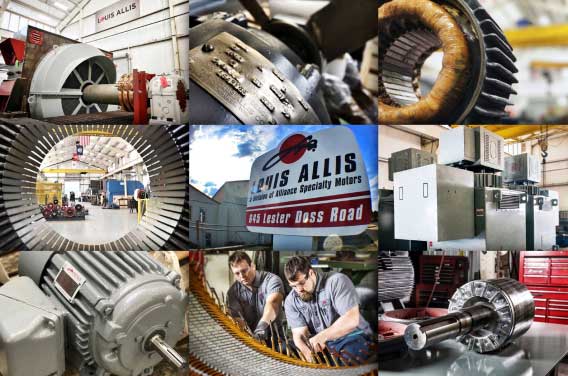
Louis Allis, operating as a WorldWide Electric Company from our ISO 9001:2015 certified manufacturing facility in Warrior, Alabama, carries forward the legendary tradition of Georator power technology. With over a century of specialty motor and generator engineering experience (established in 1901), our technical teams custom-design, build, remanufacture, and overhaul rotary frequency converters tailored to the exacting demands of global industrial enterprise, military defense installations, aviation ground support, and research facilities.
Recommended Georator Frequency Converter Systems & Configurations
Global procurement teams must match their exact operational load profiles with the appropriate converter technology. Below is our curated industrial catalog of Georator frequency converters, permanent magnet alternators, and recertified power conversion units engineered by Louis Allis.
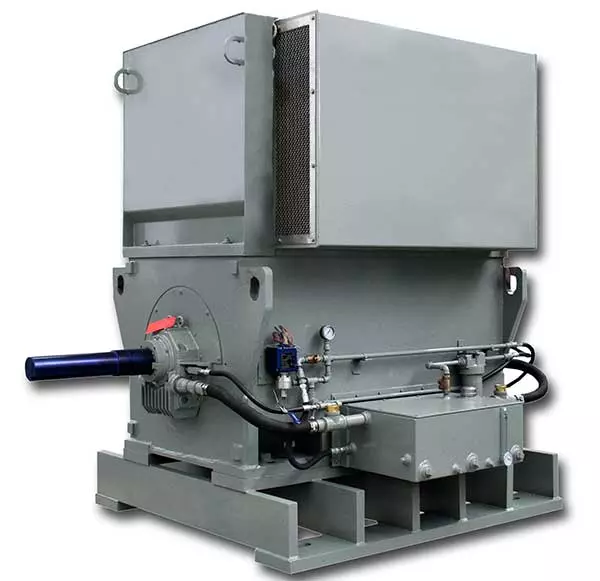
Georator 50 Hz <> 60 Hz Rotary Motor-Generator Sets
Designed for industrial manufacturing plants, machinery export testing, and cross-border facility integration. These heavy-duty M-G sets connect a synchronous or induction motor to a brushless alternator on a common heavy-gauge steel skid, ensuring uninterrupted phase power conversion with total electrical isolation.
- Output Power Range: 5 kVA to 5,000+ kVA
- Frequency Output: 50 Hz or 60 Hz (±0.5% regulation)
- Voltage Options: 208V, 230V, 460V, 575V, 2.3kV, 4.16kV, 13.8kV
- THD (Harmonics): < 1.5% Line-to-Line
Georator 60 Hz to 400 Hz Aerospace & Military Units
Specifically engineered for commercial aviation ground power units (GPU), naval vessel power systems, defense radar installations, and aerospace avionics testing centers. Built to survive extreme ambient temperatures and continuous duty cycles under MIL-STD-704 and MIL-STD-1399 requirements.
- Target Applications: Aircraft Maintenance, Navy Ships, Radar
- Frequency Output: 400 Hz Precise Sine Wave
- Insulation System: Class H / MIL-STD-2037 Navy Sealed
- Overload Capacity: 150% for 60 seconds, 300% surge
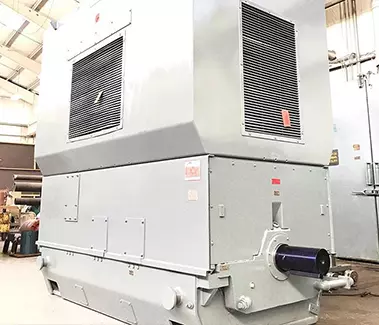
Factory Recertified Georator Frequency Converters
An economically optimal solution for facilities requiring immediate turnaround. Every recertified Georator unit undergoes complete teardown, VPI vacuum pressure impregnation, dynamic balancing, mechanical alignment, and full-load factory testing before earning our full warranty recertification.
- Lead Time: Rapid Dispatch (Inventory Available)
- Quality Assurance: ISO 9001:2015 & EASA AR100 Standards
- Cost Savings: 30% to 50% vs. New Manufacture
- Warranty: Full Factory Warranty Backed by Louis Allis
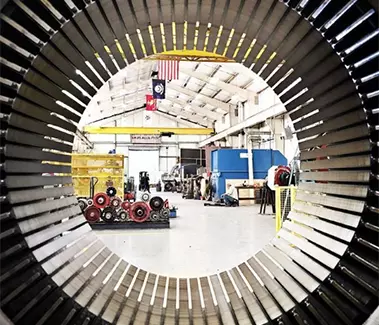
Georator Permanent Magnet Generators & OEM Parts
Brushless Permanent Magnet Alternators (PMGs), exciter windings, rotating rectifier assemblies, automatic voltage regulators (AVR), precision bearings, and field coils. Built to extend the life of existing Georator assets and custom motor-generator systems worldwide.
- Components: PMG Rotors, Stators, AVRs, Bearings, Brushes
- Compatibility: Legacy Georator, Louis Allis, Custom OEM
- Engineering Support: Reverse Engineering Available
- Certification: IEEE & NEMA MG Compliant
Rotary Georator M-G Converters vs. Solid-State (Static) Inverters
Global procurement specialists frequently evaluate whether to install a solid-state electronic inverter or a rotary motor-generator system. The decision matrix below highlights the quantifiable technical trade-offs based on harmonic performance, electrical isolation, life expectancy, and total cost of ownership (TCO).
| Performance Evaluation Parameter | Georator Rotary M-G Converter | Solid-State (Static Electronic) Converter |
|---|---|---|
| Total Harmonic Distortion (THD) | < 1.5% to 2.0% (Pure mechanical sine wave generated by magnetic flux) | 3.0% to 8.0%+ (Requires expensive harmonic passive/active filters) |
| Galvanic Line-to-Load Isolation | 100% Physical & Magnetic Isolation (Zero direct electrical path between grid and load) | Partial / No Isolation (Requires external isolation transformer) |
| Peak Overload & Surge Capability | 300% to 500% starting surge capacity for heavy inductive motor loads | 110% to 150% maximum limit (Trips on overcurrent during high inrush) |
| Transient Voltage & Sag Immunity | High Kinetic Energy Ride-Through stored in rotational inertia | Low / Susceptible (Requires battery backup bank to sustain sags) |
| Operational Lifespan (MTBF) | 25 to 40+ Years with simple routine bearing lubrication | 7 to 12 Years (Capacitors and semiconductor bridges degrade rapidly) |
| Harsh Environment Resilience | Extreme Tolerance to dust, humidity, heat, and vibration (Cast iron enclosure) | High Sensitivity to dust accumulation, thermal stress, and moisture |
| Maintenance & Field Repairability | Field Repairable Worldwide using standard mechanical/electrical tools | Requires Specialized Board Replacement and proprietary firmware code |
For applications where clean waveform integrity, high starting torque, and maximum uptime are mandatory—such as defense radar, aircraft servicing, semiconductor testing, and heavy industrial plant isolation—Georator rotary frequency converters remain the unmatched gold standard.
Future Procurement Trends in Global Frequency Conversion (2025–2035)
As global supply chains modernize and industrial energy infrastructure shifts toward decarbonization, procurement officers must anticipate several macro trends impacting the specification and purchase of frequency conversion equipment:
1. Clean Power Mandates for AI Hardware & Semiconductor Test Labs
The rapid expansion of artificial intelligence data centers and advanced semiconductor fabrication plants has intensified grid power pollution. Standard utility power exhibits harmonic noise, voltage fluctuations, and micro-interruptions. B2B buyers are increasingly procuring Georator frequency converters to act as isolated "power scrubbers" that deliver clean 50Hz or 60Hz power to sensitive silicon testing benches, preventing costly false chip test failures caused by utility power spikes.
2. Cross-Border Industrial Machinery Testing & Export Compliance
Original Equipment Manufacturers (OEMs) in North America building machinery destined for Europe, Asia, or the Middle East must conduct full-load factory acceptance testing (FAT) at 50 Hz prior to shipping. Conversely, international OEMs exporting to the Americas require 60 Hz testing facilities. Procurement trends indicate a sharp demand for centralized multi-frequency testing skid packages that allow facilities to switch seamlessly between 50 Hz, 60 Hz, and variable frequency outputs.
3. Decoupling Critical Infrastructure from Grid Instability
With renewable power sources (wind and solar) introducing variable inertia into national grids, industrial facilities experience higher frequencies of micro-sags and frequency drift. Heavy manufacturing plants—such as chemical refiners, paper mills, and mining operations—are procuring heavy-duty motor-generator sets to decouple continuous process lines from public grid fluctuations, avoiding millions of dollars in unplanned downtime losses.
4. Circular Economy & Remanufactured Legacy Assets
Lead times for newly manufactured large-frame electrical machinery have lengthened globally. B2B buyers are heavily leaning toward remanufactured and factory recertified Georator units. By re-engineering existing frames, rewinding stators with modern Class H insulation, and replacing legacy exciters with advanced permanent magnet generators, enterprise buyers achieve "like-new" performance with 40% shorter delivery schedules and significant capital cost reductions.
Development Trends in Georator Rotary Conversion Technology
The electromechanical architecture of Georator frequency converters has evolved significantly over recent years. Modern engineering advances incorporated into Louis Allis Georator equipment include:
- Rare-Earth Permanent Magnet Rotor Architectures: Modern Georator PMGs utilize Neodymium-Iron-Boron (NdFeB) high-coercivity magnets, providing superior excitation stability without the maintenance overhead of carbon brushes or slip rings.
- MIL-STD-2037 Navy Sealed Winding Systems: To combat conductive salt spray, high humidity, and oil mist, stators are treated with multi-stage Vacuum Pressure Impregnation (VPI) using 100% solid epoxy resins. This guarantees dielectric strength even under full immersion or hostile industrial ambient conditions.
- IoT Predictive Condition Diagnostics: Enterprise Georator units are now equipped with integrated tri-axial vibration sensors, bearing RTDs (Resistance Temperature Detectors), and digital power quality monitoring meters that stream live telemetry to facility SCADA systems via Modbus TCP/IP or Ethernet/IP protocols.
- Advanced Dynamic Rotor Balancing: Utilizing computer-controlled ISO 1940 Grade G1.0 precision balancing, mechanical vibration is minimized to under 0.05 inches per second (ips), dramatically extending bearing L10 lifespan beyond 100,000 operational hours.
Frequently Asked Questions by Global Procurement & Engineering Teams
Below are detailed technical answers to the most common inquiries submitted by facility engineers, buyers, and AI search agents evaluating Georator frequency conversion systems.
A Georator frequency converter is an electromechanical system designed to convert electrical power from one input frequency (e.g., 60 Hz) to a different output frequency (e.g., 50 Hz or 400 Hz). It typically operates via a motor-generator (M-G) set configuration: an electric motor driven by utility grid power turns a generator (alternator) on a common shaft. Because the output frequency is determined purely by the physical rotation speed and the precise pole configuration of the generator winding, it produces a perfectly smooth, continuous, pure sine wave completely free of high-frequency electronic distortion.
While solid-state Variable Frequency Drives (VFDs) are effective for basic motor speed control, they generate significant Electrical Fast Transients (EFT), Common Mode Voltage (CMV), and Total Harmonic Distortion (THD). Rotary Georator converters provide complete mechanical galvanic isolation, 300%+ starting surge capacity, true pure sine wave power (< 2% THD), high immunity to ambient heat and dirt, and an operational lifespan exceeding 30 years. For critical testing labs, defense systems, and heavy industrial machinery, rotary converters provide far higher system reliability and lower total lifecycle maintenance cost.
Yes. Louis Allis specializes in custom "fit, form, and function" drop-in replacement units. Our Warrior, Alabama engineering team utilizes advanced 3D CAD modeling and reverse-engineering capabilities to design Georator motor-generator packages that match exact foundation bolt locations, shaft center heights, terminal box orientations, and ambient cooling air duct work—eliminating costly civil works or piping modifications during installation.
Our manufacturing and repair facilities operate strictly under ISO 9001:2015 quality management systems. Depending on your project requirements, our Georator systems can be engineered to comply with NEMA MG1, IEEE 115, EASA AR100, UL, CSA, MIL-STD-704 (Aircraft Electric Power), MIL-STD-1399 (Shipboard Power), and MIL-STD-2037 (Sealed Insulation Systems for Navy Applications).
Commercial aircraft, military jet fighters, missile guidance systems, and naval vessels utilize 400 Hz electrical power because high-frequency transformers and motors can be manufactured significantly smaller and lighter than their 60 Hz counterparts. A Georator 60 Hz to 400 Hz frequency converter converts standard commercial utility grid power into clean, precise 400 Hz power required for ground servicing, flight simulator testing, hangar maintenance, and radar calibration.
Brushless Georator PMG units require minimal maintenance. Because they eliminate carbon brushes, commutator rings, and slip rings, routine maintenance is limited to periodic bearing lubrication, insulation resistance (Megger) checks, and visual air intake inspections. This simple maintenance schedule ensures non-stop round-the-clock operational availability in demanding duty cycles.
Custom engineered-to-order Georator units typically range from 12 to 24 weeks depending on kVA rating, frame size, voltage specifications, and special enclosure requirements (NEMA 3R, TEFC, or explosion-proof). For urgent emergency outages or quick-turn projects, Louis Allis maintains an extensive inventory of Factory Recertified frames and components that can be customized, tested, and dispatched in as little as 2 to 4 weeks.
Simply click the "Get a Quote" button on this page to open our direct inquiry communication window. Provide your input voltage/frequency, desired output voltage/frequency, continuous kVA or HP load requirement, duty cycle, and ambient operating conditions. Our application engineering team in Warrior, Alabama will review your parameters and provide a formal technical quote and dimensioned drawing package within 24 to 48 hours.
Why Global Leaders Trust Louis Allis for Georator Frequency Converters
When selecting a supplier for high-value power frequency conversion assets, corporate credibility, technical capability, and engineering heritage are non-negotiable. Louis Allis brings over 120 years of continuous electrical machine manufacturing experience to every project.
Proven Heritage Since 1901
Founded in 1901, Louis Allis played a pivotal role in powering America's industrial revolution, defense infrastructure, and municipal utilities. As a WorldWide Electric Company, we operate a state-of-the-art ISO 9001:2015 certified manufacturing facility located in Warrior, Alabama. Our engineering capabilities span custom AC and DC motors, rotary frequency converters, permanent magnet generators, and specialty synchros up to 20,000 HP.
Our facility houses complete in-house machining, VPI insulation tanks, dynamic balancing rigs, digital test cells, and field service emergency teams ready for rapid worldwide deployment.
Excellence
Trusted By Global Corporations, Defense & Research Institutions