| Typical Power Output |
Approximately 100 kW to several megawatts |
Electrical input is converted into mechanical torque through the interaction between the armature current and the magnetic field. |
Supports high-load equipment such as rolling mills, cranes, hoists, conveyors, and large machine tools. |
| Common DC Voltage |
Typically 220 V to 1,000 V DC, depending on system design |
A controlled DC supply regulates the voltage applied to the armature and field circuits. |
Allows the motor to be matched to the plant's power architecture and required torque level. |
| Speed Control |
Wide adjustable range; commonly controlled from near zero to rated speed |
Armature voltage primarily controls speed below base speed, while field weakening can increase speed above base speed within safe limits. |
Provides precise control during starting, acceleration, production changes, and stopping. |
| Starting Torque |
High starting torque, often approaching rated torque when properly controlled |
Torque is approximately proportional to armature current and field flux: T ∝ Φ × Ia. |
Enables reliable starting of heavy loads without requiring a separate mechanical starting device. |
| Torque Response |
Fast response when used with a suitable electronic drive |
The drive adjusts armature voltage and current rapidly in response to speed or torque feedback. |
Improves process stability in applications requiring frequent load changes. |
| Operating Efficiency |
Commonly about 85% to 95%, depending on size, load, speed, and condition |
Efficiency is affected by copper losses, iron losses, friction, windage, brush losses, and auxiliary cooling power. |
High efficiency can reduce operating energy costs, especially in continuous-duty applications. |
| Duty Capability |
Suitable for continuous, short-time, and frequent-cycling duty when correctly specified |
Thermal design, cooling capacity, insulation class, and load profile determine allowable operating conditions. |
Can handle demanding production cycles when the motor is selected according to real thermal and mechanical loads. |
| Main Control Components |
Controlled rectifier or DC drive, field regulator, feedback device, and protection system |
The drive manages armature current, field current, acceleration, braking, and fault protection. |
Provides coordinated control, overload protection, and integration with industrial automation systems. |
| Regenerative Braking |
Available when the drive and power system support energy feedback |
During braking, the motor operates as a generator and sends electrical energy back to the DC supply or braking system. |
Can improve braking control and reduce energy wasted as heat in suitable applications. |
| Cooling Methods |
Natural ventilation, forced-air cooling, or enclosed air-to-air cooling |
Cooling equipment removes heat generated by electrical and mechanical losses from the motor enclosure. |
Helps maintain insulation life, stable performance, and allowable continuous output. |
| Mechanical Construction |
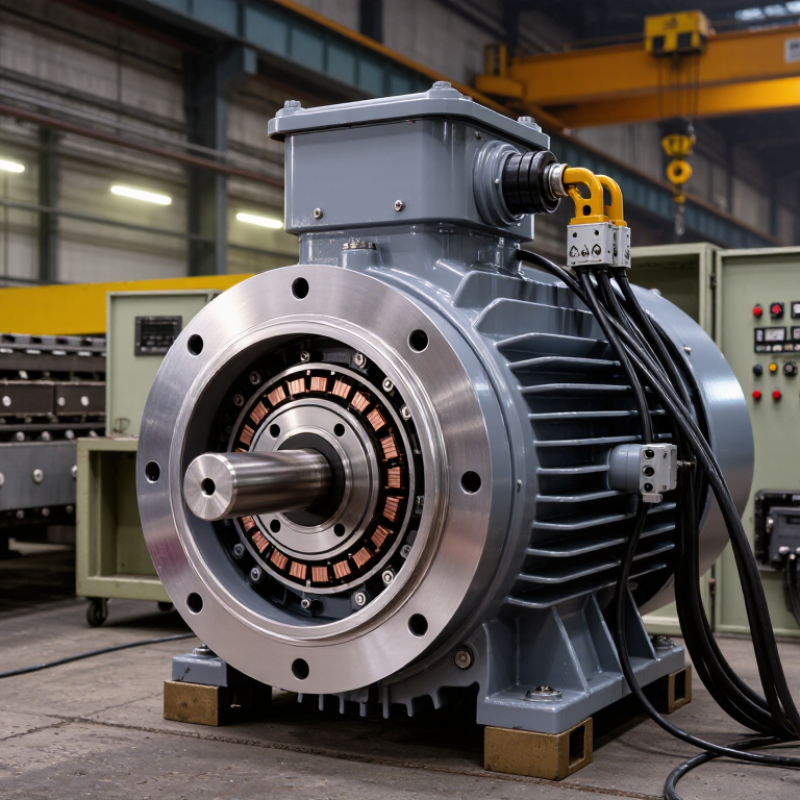
Laminated steel magnetic core, copper windings, commutator, brushes, bearings, and robust frame |
The armature rotates inside the magnetic field; the commutator and brushes switch current direction to maintain continuous torque. |
Provides high torque density and smooth controllability for large industrial machines. |
| Maintenance Requirements |
Regular inspection of brushes, commutator surface, bearings, insulation, cooling passages, and alignment |
Wear components and contamination are monitored through scheduled inspections and condition-based maintenance. |
Planned maintenance can reduce unplanned downtime and extend service life. |
| Overload Capability |
Application-dependent; short-term overloads require verification of thermal and drive limits |
The drive limits current to protect the armature, commutator, brushes, and power electronics. |
Allows temporary load peaks while maintaining protection against excessive heating and mechanical stress. |
| Typical Industrial Uses |
Cranes, hoists, elevators, rolling mills, paper machines, test stands, conveyors, and mine hoists |
Large DC motors deliver controlled torque and variable speed through closed-loop or open-loop drive systems. |
Well suited to applications requiring high starting torque, precise speed control, or frequent acceleration and braking. |
| Key Selection Factors |
Rated power, torque, speed range, duty cycle, load inertia, ambient conditions, cooling, and drive compatibility |
Motor performance is evaluated against both steady-state requirements and transient operating conditions. |
Correct selection improves reliability, energy performance, safety, and total lifecycle value. |
| Primary Limitation |
Brushes and commutators require inspection and may be sensitive to dust, vibration, humidity, and poor adjustment |
Mechanical switching introduces wear and can produce electrical arcing if the motor or drive is incorrectly operated. |
Maintenance planning and correct environmental protection are essential for reliable long-term operation. |